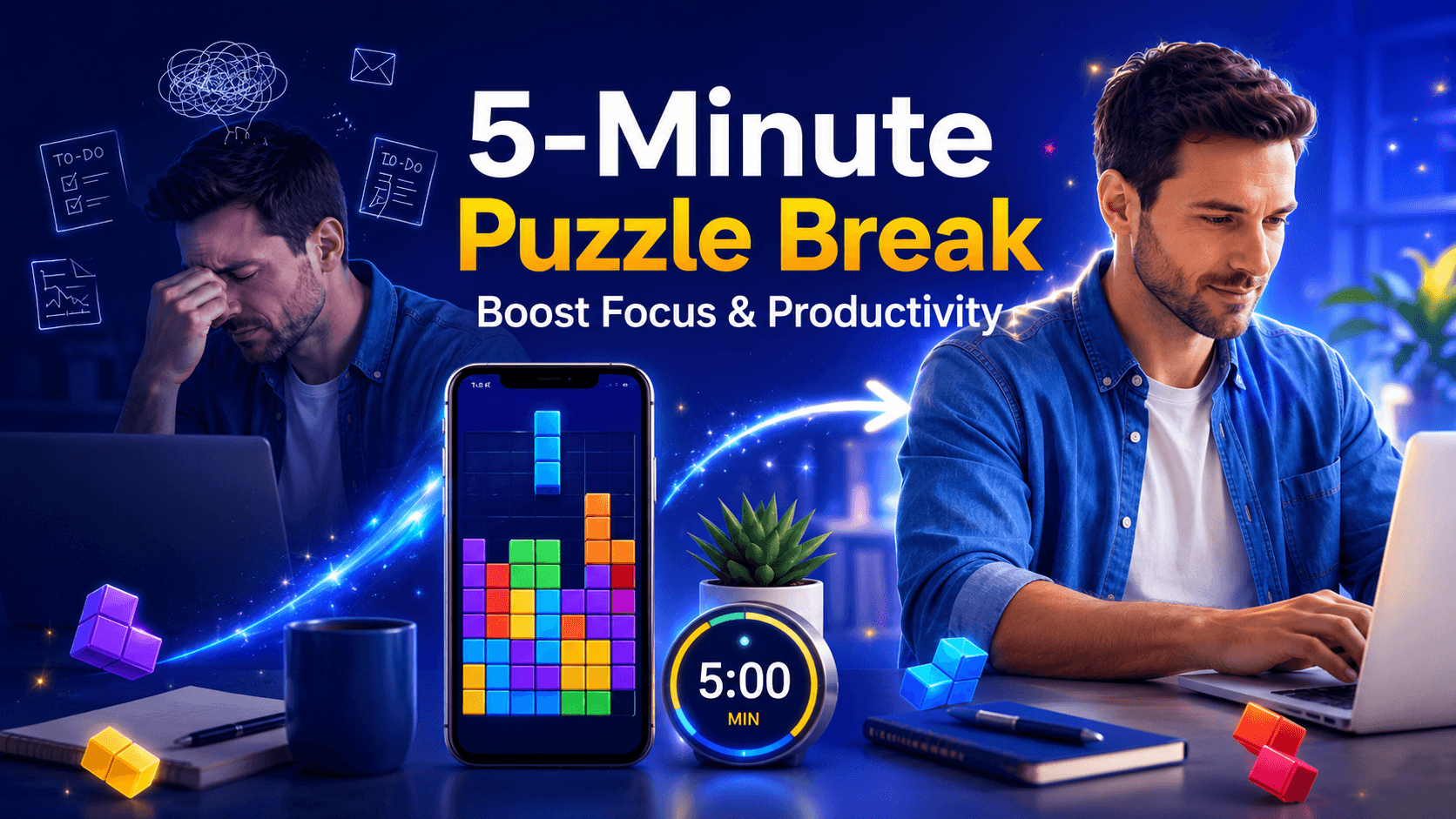
You’re mid-task, your focus is fading, and you open a puzzle game for a few minutes. Then a small voice in your head asks if you’re just procrastinating.
The truth is, a short puzzle game productivity break can genuinely improve your focus afterward, because it gives your brain a real pause from sustained attention instead of forcing it to keep pushing through mental fatigue. The key is that it has to be a true break, not another demanding task disguised as one.
That is where a quick puzzle game can help. It gives your mind something simple, structured, and low-pressure to do. You are not answering emails. You are not checking news. You are not getting pulled into social media drama. You are just giving your brain a few minutes to reset.
The goal is not to escape work for half an hour. The goal is to step away for five minutes, refresh your attention, and come back with a clearer mind.
Let’s look at why this works, why puzzle games are different from many other breaks, and how to use them without letting a quick pause turn into lost time.
The Science: What a Mental Break Actually Does
A mental break helps your brain recover from sustained attention, which is the kind of focus you use when you write, study, solve problems, plan work, or make decisions. When you keep forcing your brain to concentrate without pause, your attention becomes weaker, slower, and easier to distract.
You may have felt this many times. At first, you are working well. Then reading the same line takes longer. Small tasks feel heavier. You check the time more often. You open another tab without thinking. Your brain is still present, but it is no longer sharp.
That does not always mean you are lazy. It often means your attention needs a reset.
Why Does a Short Break Improve Focus Afterward?
A short break improves focus afterward because it gives your brain a chance to stop using the same mental pathway for a few minutes. Instead of forcing yourself through tired concentration, you briefly switch into a lighter activity that does not demand the same level of effort.
Think of attention like a phone battery. You can keep using it at low power, but everything becomes slower. A short break is not a full recharge, but it can bring enough energy back to make the next task feel easier.
This is why “just push through it” does not always work. Sometimes pushing harder only makes you slower. You spend twenty minutes fighting a task that might have taken ten minutes after a proper pause.
A five-minute break can create just enough distance from the task. When you return, the problem may feel less stuck. The sentence may be easier to write. The spreadsheet may look less confusing. The decision may feel clearer.
Why Switching Tasks Is Not the Same as Resting
Not every break is really a break. Checking email, replying to messages, scrolling social media, or reading the news can feel like rest because you are no longer doing your main task. But your brain is still processing information, making decisions, reacting emotionally, and switching attention quickly.
That is why you can take a “break” and come back feeling more tired than before.
Email keeps your brain in work mode. Social media gives you too many quick signals at once. News can add stress. Even watching short videos can pull your attention in different directions so quickly that your mind does not actually settle.
A good focus break should feel light, simple, and contained. It should not create a new list of things to think about. It should not leave you more distracted than when you started.
A calm puzzle game can work well because it gives your brain a clear activity without turning the break into another mental burden.
Why Five Minutes Is the Sweet Spot
Five minutes is long enough to step away from work, but short enough to keep your momentum. That balance matters.
If the break is too short, your brain may not actually disengage. You might still be thinking about the same task. But if the break becomes too long, it gets harder to return. Your body relaxes too much, your mind drifts, and suddenly the task you paused feels even harder to restart.
A five-minute puzzle game break sits in the middle. You get a small reset without losing the thread of your day.
It is especially useful between tasks. For example, after finishing a client message and before starting a report. Or after studying one topic and before moving to the next. These small pauses help your brain close one mental tab before opening another.
That is where productivity improves. Not because the game magically makes you smarter, but because it helps you return to work with less mental noise.
Why a Puzzle Game Works Better Than Other Breaks
A puzzle game works better than many common breaks because it gives your brain a light challenge with structure, closure, and low emotional pressure. It keeps your attention gently engaged without overwhelming it.
Here is how it compares with other common break habits:
| Break Type | What Usually Happens | Effect on Focus |
|---|---|---|
| Scrolling social media | Endless content keeps pulling you forward | Often leaves your mind more scattered |
| Checking email | You enter work mode again and find new tasks | Does not feel like a real break |
| Reading the news | Can add stress or emotional load | May reduce calm and clarity |
| Watching short videos | Fast switching keeps attention jumping | Can make it harder to return to deep work |
| Staring at a wall | Sounds peaceful but is hard to maintain | Works for some people, but not for everyone |
| Playing a calm puzzle game | Gives a small goal with a clear stopping point | Can refresh focus without adding stress |
The difference is structure.
A puzzle game gives you something simple to complete. Clear a line. Place a block. Beat a small score. Solve a small pattern. These micro-goals give your brain a quick feeling of progress without the pressure of a major task.
That little sense of completion matters. Many work tasks are open-ended. A report can always be improved. A design can always be adjusted. A business plan can always be refined. Your brain rarely gets a clean “done” moment.
Puzzle games provide that in small doses.
They also avoid the emotional pull of many other apps. A calm puzzle game does not need breaking news, comments, arguments, or endless feeds to keep you engaged. It can be interesting without being stressful.
That is why a block puzzle game can sit in a useful middle ground. It is not so boring that your mind keeps drifting back to work. It is not so intense that you feel more wired afterward. It gives your attention somewhere gentle to land.
How to Actually Do This Without It Backfiring
A puzzle game break works best when you use it with boundaries. Without boundaries, five minutes can easily become twenty-five, and then the break stops helping productivity.
So the first rule is simple: set a timer before you start.
This sounds obvious, but it changes the whole experience. When the timer is already running, you do not need to keep checking whether you have played too long. You can relax into the break because the limit is clear.
The second rule is to choose the right kind of game. A good productivity break game should be calm, simple, and easy to pause. Untimed puzzle games are usually better than fast, competitive, or high-pressure games because they do not make you feel rushed.
You want a game that lets you stop naturally. Not one that punishes you for leaving. Not one that keeps pushing you into another match. Not one that makes your heart race when your goal is to reset your mind.
The third rule is to use the break between tasks, not in the middle of deep work.
If you are fully focused, do not interrupt yourself just because the idea of a break sounds nice. Use puzzle game breaks when your focus is already fading, or when you have finished one task and are about to start another.
Good moments include after sending an email, after completing a study session, after a meeting, after finishing a design draft, or before starting a task that needs fresh attention.
The fourth rule is to return with one clear next step.
Before you start the break, decide what you will do afterward. For example: “After five minutes, I will write the next paragraph,” or “After this break, I will review the invoice list,” or “After the timer ends, I will start the next lesson.”
This keeps the break connected to productivity instead of letting it become an escape.
Where Tetra Brick Fits
If you want to try this kind of focus break, the game matters more than you might think. Tetra Brick fits naturally because it is built around calm, short puzzle sessions that you can pick up and put down without pressure.
There is no need for a long setup. You do not need to prepare anything. You can open it, play for a few minutes, and step away when your timer ends.
That makes it useful for a real five-minute break. You are not waiting for a complicated level to load. You are not locked into a long match. You are not pushed by a timer that makes the break feel stressful.
The no-time-limit style is important. A productivity break should not feel like another deadline. It should give your mind room to breathe while still giving you a simple challenge.
Offline play also helps. If you are traveling, sitting between tasks, waiting for a call, or taking a quick pause away from WiFi, the break is still available. You do not need to scroll social media just because it is the easiest option.
Tetra Brick is not about replacing work. It is about giving your brain a clean, calm pause so you can return to work with better focus.
Try setting a five-minute timer, playing one short session, and noticing how your mind feels afterward.
Quick FAQ
Is gaming at work actually a productivity killer?
Gaming at work can hurt productivity if it becomes a long distraction. But a short, controlled puzzle game break can help if it is used intentionally, especially when your focus is already fading and you need a quick reset.
How long should a focus break be?
A good focus break can be around five minutes. That is usually enough time to step away from mental strain without losing your motivation to return to the task.
Are puzzle games better than scrolling social media for a break?
Puzzle games can be better than scrolling because they are more structured and less emotionally noisy. Social media often pulls you into endless content, while a calm puzzle game gives you a simple activity with clearer stopping points.
Final Thoughts
Taking a break is not the opposite of being productive. Sometimes it is the thing that makes the next hour of work possible.
The important part is choosing a break that actually helps your brain rest. A short puzzle game break can work because it is simple, structured, and easy to fit between tasks. It gives your attention somewhere calm to go, without adding the stress and noise that often comes from emails, news, or social media.
The goal is not to play all day. The goal is to pause for a few minutes, reset your focus, and return with a clearer mind.
Used the right way, a five-minute Tetra puzzle game productivity break can be a small habit that supports better focus, better energy, and a smoother workday.