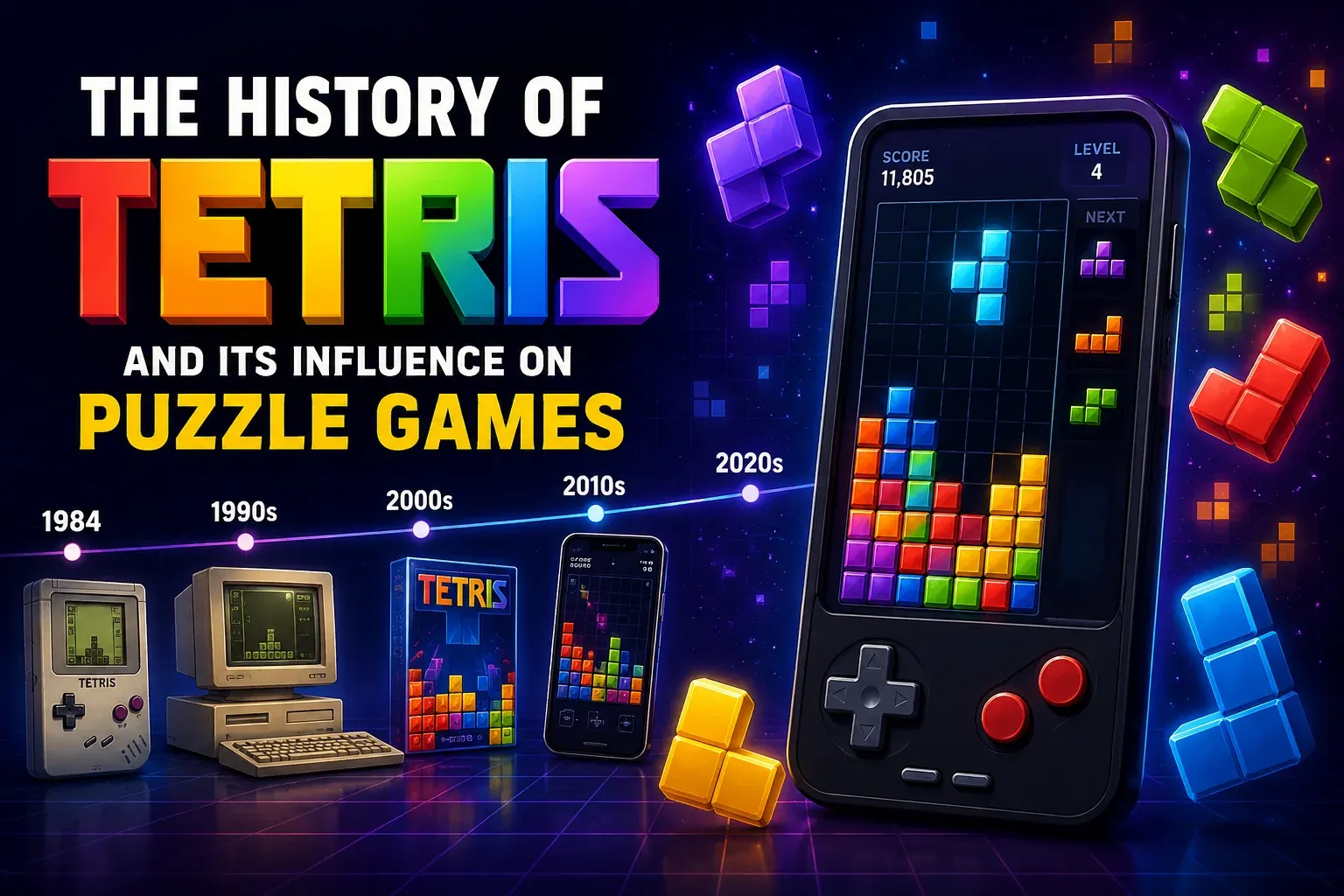
Quick answer: Tetris was created in 1984 by Alexey Pajitnov, a software engineer at the Soviet Academy of Sciences in Moscow, inspired by a puzzle called pentominoes. It spread to home computers in the late 1980s and became a global phenomenon after Nintendo bundled it with the Game Boy in 1989. Its simple idea of fitting falling shapes together to clear lines became the template for the block puzzle genre, inspiring countless modern games, including calmer, drag-and-drop takes like Tetra Brick Puzzle.
Introduction
Few video games can claim to have changed the world. Tetris is one of them.
It has no characters, no story, and no dialogue, just seven simple shapes and an empty well. Yet for more than four decades, it has been played on almost every screen imaginable, from Soviet lab computers and pocket handhelds to smartphones and championship stages.
So how did a game made in Moscow during the Cold War end up becoming one of the most recognisable games ever? And how did it shape the puzzle games we play today? Let's go back to the beginning.
Where Did Tetris Come From?
In 1984, Alexey Pajitnov was working as a researcher at the Dorodnitsyn Computing Centre of the Soviet Academy of Sciences in Moscow. His job involved artificial intelligence and speech recognition, but in his spare time he loved puzzles and wanted to test what the centre's computers could do.
One of his favourite puzzles was pentominoes, a classic game where you arrange shapes made of five squares to fit into a box. Pajitnov simplified the idea to shapes made of four squares, known as tetrominoes, and added a twist: the pieces would fall, and complete rows would disappear.
He built the first version on an Electronika 60, a Soviet computer so basic it could only display text, so the blocks were drawn using bracket characters. The name "Tetris" combined tetra (the Greek word for four) with tennis, Pajitnov's favourite sport.
From a Moscow Lab to the Rest of the World
Tetris spread quickly among Pajitnov's colleagues, who found it impossible to stop playing. A young programmer, Vadim Gerasimov, soon helped port it to the IBM PC, and copies began travelling across the Soviet Union and Eastern Europe on floppy disks.
Getting the game to the West was far more complicated. In the Soviet system, software created at a state institute belonged to the state, and Pajitnov did not own the rights to his own creation. What followed was a famously tangled series of licensing deals involving Western publishers, a state agency called Elorg, and several companies all believing they held the rights.
The story eventually involved Dutch-American game designer Henk Rogers, who travelled to Moscow and secured the handheld rights for Nintendo. That deal changed everything.
The Game Boy Moment
In 1989, Nintendo launched the Game Boy and included Tetris with the console in North America and Europe.
It was a perfect match. Tetris was easy to understand, endlessly replayable, and ideal for short sessions on the go, exactly what a portable console needed. Players of every age picked it up, and for many people, Tetris was the Game Boy.
This was the moment Tetris went from a popular computer game to a true cultural phenomenon.
Key Moments in Tetris History
| Year | Milestone |
|---|---|
| 1984 | Alexey Pajitnov creates Tetris on an Electronika 60 in Moscow |
| Mid-1980s | The game is ported to the IBM PC and spreads across the Soviet Union |
| Late 1980s | Versions appear on home computers in the West amid complex licensing battles |
| 1989 | Tetris is bundled with Nintendo's Game Boy and becomes a global hit |
| 1996 | Pajitnov and Henk Rogers form The Tetris Company, and Pajitnov finally begins earning royalties |
| 2010 | The Classic Tetris World Championship begins, growing a competitive scene |
| 2023 | A feature film dramatises the story of the Game Boy licensing deal |
| Today | Tetris and the games it inspired are played on consoles, computers, and phones worldwide |
Why Tetris Was So Revolutionary
Puzzle games existed before Tetris, but none had combined so many qualities in such a simple package:
- Instant understanding. You grasp the goal within seconds, without reading anything.
- Real-time decisions. Pieces keep falling, so you think and act at the same time.
- Spatial reasoning. Every move is about picturing how shapes fit together.
- Endless play. There's no final level, only a higher score to chase.
- Rising difficulty. The game speeds up, so it always pushes you a little further.
Tetris even gave its name to a psychological idea. The "Tetris effect" describes what happens when people play something so much that it starts to shape their thoughts and dreams, like seeing falling blocks when they close their eyes, or mentally fitting real-world objects together.
How Tetris Shaped Modern Puzzle Games
Tetris didn't just become popular. It created a blueprint that game designers still follow today.
It proved simple can be deep. Tetris showed that a game with very few rules could offer years of challenge. That idea runs through modern casual and puzzle games.
It made puzzles mainstream. Before Tetris, puzzle games were often seen as niche. Afterwards, they were something everyone played, from children to grandparents.
It launched the block puzzle genre. The core mechanic of filling a grid and clearing complete lines has inspired a huge family of games. Some keep the falling pieces and rising speed; others reimagine the formula entirely.
It paved the way for mobile gaming. The qualities that made Tetris perfect for the Game Boy, short sessions, simple controls, and instant fun, are the same qualities that made puzzle games so successful on smartphones. Later hits in other puzzle styles, such as tile-matching games, built on that same foundation of easy-to-learn, hard-to-master play.
Tetra Brick Puzzle: A Modern Take on the Classic Idea
Tetra Brick Puzzle is one of the many games inspired by that original spark. It keeps the heart of the classic formula, fitting brick shapes onto a grid and clearing complete lines, but reimagines how you play.
Instead of pieces falling and speeding up, you drag them from a tray and place them wherever you like, with no time limits. The focus shifts from reflexes to planning, making it a calmer, more strategic experience that suits today's busy lives.
| The original falling-block formula | Tetra Brick Puzzle | |
|---|---|---|
| Core idea | Fit shapes to clear lines | Fit shapes to clear lines |
| How pieces arrive | Fall from the top | Wait in a tray |
| Pace | Speeds up over time | Always your own pace |
| Main skill | Reflexes and quick thinking | Planning and strategy |
| Where you play | Many platforms | iPhone, even offline |
If you'd like to know more about how the two compare, read why Tetra Brick Puzzle is the ultimate Tetris-inspired game for puzzle lovers.
Why the Legacy Still Matters
More than 40 years later, the influence of Tetris is everywhere. Competitive players still push the limits of the classic versions. New generations discover block puzzles on their phones every day. And designers keep finding fresh ways to reinvent the simple pleasure of making shapes fit.
That staying power says something about great game design: the best ideas are often the simplest. For a closer look at why the genre has lasted, see why Tetris-style puzzle games are still popular in 2026.
Frequently Asked Questions
Who invented Tetris?
Tetris was invented by Alexey Pajitnov, a software engineer working at the Soviet Academy of Sciences in Moscow, in 1984.
What inspired Tetris?
Pajitnov was inspired by pentominoes, a puzzle in which you arrange shapes made of five squares. He simplified it to four-square shapes and made them fall.
Why is it called Tetris?
The name combines tetra, Greek for four, after the four squares in each piece, with tennis, Pajitnov's favourite sport.
When did Tetris become popular worldwide?
It spread through computers in the late 1980s, but became a global sensation after it was bundled with the Nintendo Game Boy in 1989.
What is the Tetris effect?
The Tetris effect describes how repeating an activity, like playing Tetris for hours, can shape your thoughts, mental images, and even dreams.
Is Tetra Brick Puzzle a Tetris game?
No. Tetra Brick Puzzle is an independent block puzzle game inspired by classic games like Tetris. It's available on iPhone through the App Store.
Final Thoughts
The story of Tetris is remarkable: a puzzle built for fun in a Moscow research lab that crossed the Iron Curtain, reshaped the games industry, and became a shared memory for millions of people around the world.
Its simple idea of fitting shapes together and clearing lines still inspires new games today. Tetra Brick Puzzle is one modern way to enjoy that legacy, at your own pace and without the rush.
👉 Download Tetra Brick Puzzle on the App Store and experience a modern, relaxed take on classic block puzzle fun.