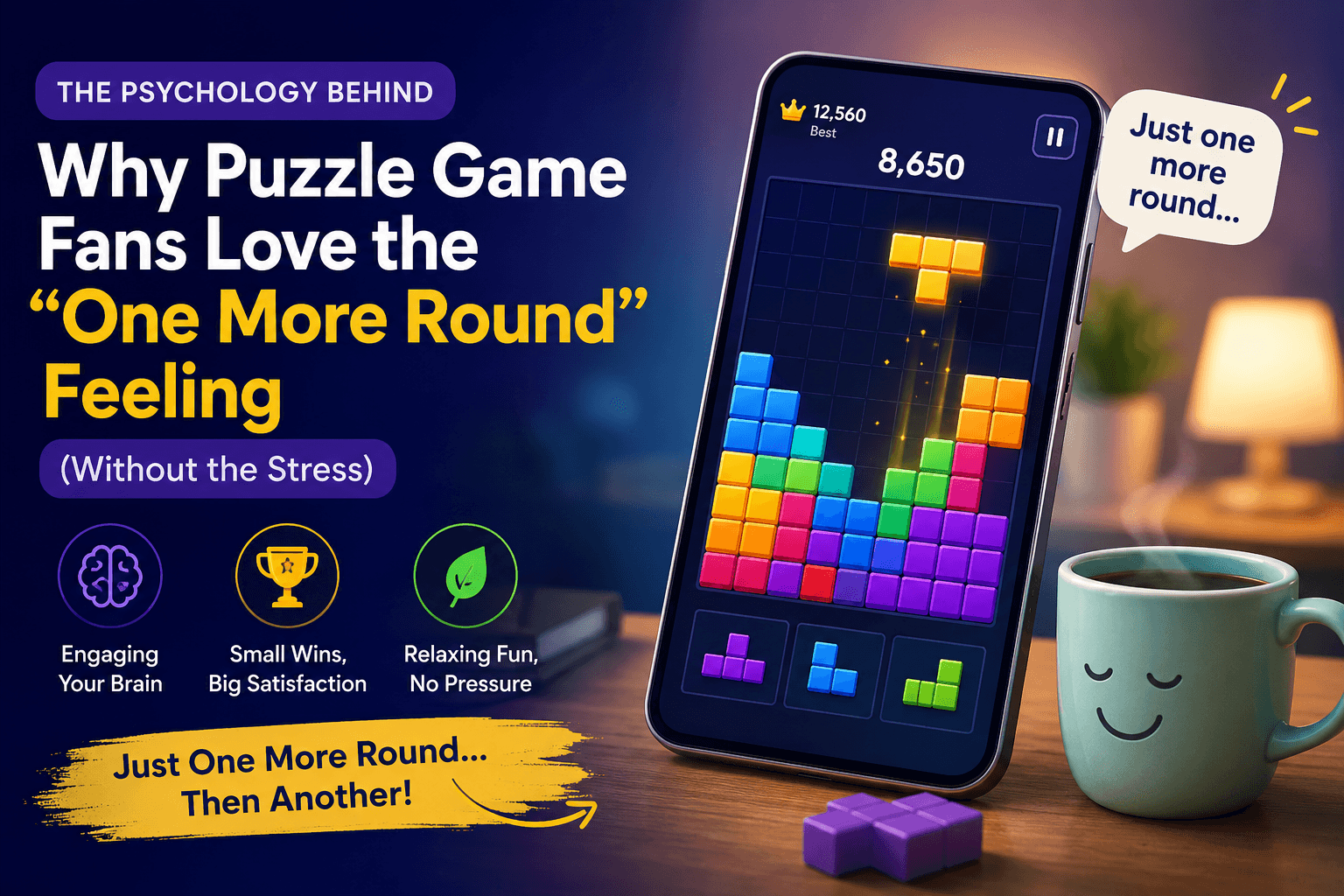
You Said “One More Round.” Then Somehow 20 Minutes Passed.
You've probably experienced it before.
You finish a puzzle, clear a few blocks, and tell yourself you'll stop after one more round. Then another. And another.
The surprising part isn't that time passes quickly. It's that you don't feel drained afterward.
Unlike doomscrolling social media or playing high-pressure competitive games, a good one more round puzzle game often leaves you feeling calm, focused, and mentally refreshed. Instead of stress, there's satisfaction. Instead of frustration, there's a sense of progress.
That's not an accident.
The "one more round" feeling is rooted in how our brains respond to small challenges, achievable goals, and rewarding feedback loops. When designed well, puzzle games create a balance between engagement and relaxation that keeps players coming back without making them feel overwhelmed.
In this post, we'll explore the psychology behind that feeling, why it feels so good, and why certain puzzle games seem to deliver it better than others.
What Is the “One More Round” Feeling, Exactly?
The "one more round" feeling is the urge to continue playing after completing a game session because the experience feels rewarding, achievable, and mentally satisfying. Rather than creating pressure, it gives players a sense of momentum and curiosity about what comes next.
In puzzle games, this feeling usually happens when each round is short, progress feels meaningful, and success is within reach. That's why many players return to a relaxing puzzle game even when they originally planned to stop after a single round.
Psychologists often describe this experience as a balance between challenge and skill. The task isn't so easy that it becomes boring, but it's not so difficult that it becomes frustrating. Your brain stays engaged without feeling overloaded.
This balance creates what many researchers call a "flow state" — a condition where you're fully focused on an activity while losing track of time.
When players enter this state, continuing for "just one more round" feels natural.
Why It Feels Good Instead of Feeling Guilty
Not every game creates a positive "one more round" experience.
Some games rely heavily on pressure, urgency, or fear of missing out. Those experiences can leave players feeling exhausted after long sessions.
Puzzle games work differently.
A well-designed puzzle game rewards the brain with small moments of accomplishment. Every completed row, solved pattern, or strategic move provides immediate feedback that says, "Good job. You're making progress."
Our brains naturally enjoy progress.
Researchers have long observed that humans feel motivated when moving toward a goal, even if the goal is relatively small. Puzzle games provide dozens of these tiny victories within a short period.
That's why clearing a difficult section of blocks feels surprisingly satisfying.
Another reason the experience feels good is predictability.
In everyday life, many things feel uncertain. Work deadlines change. Notifications constantly interrupt us. Social feeds never really end.
Puzzle games offer a rare sense of control.
You understand the rules. You see the challenge. You make the decisions.
That feeling of control can be deeply relaxing.
Instead of reacting to chaos, you're solving a problem at your own pace.
The Brain Loves Small Wins
One reason puzzle games remain popular year after year is their ability to deliver consistent, manageable rewards.
Think about what happens when you complete a puzzle objective.
You place the right piece.
You clear a line.
You create space for future moves.
Your brain immediately recognizes progress.
This triggers positive reinforcement, encouraging you to continue.
Unlike larger achievements that may take weeks or months to reach, puzzle games provide rewards every few minutes. These small wins keep motivation high without creating pressure.
The best puzzle games don't require massive commitments.
You can play for three minutes or thirty.
Either way, you walk away feeling like you've accomplished something.
That flexibility is one reason casual puzzle games have become a preferred form of mobile entertainment for millions of players.
Why Short Rounds Are So Powerful
Many successful puzzle games share one important characteristic:
Rounds are short.
This might seem like a simple design choice, but it has a significant psychological impact.
When a round only lasts a few minutes, starting another feels easy.
You're not committing to a long gaming session.
You're simply giving yourself one more opportunity to improve your score, solve another challenge, or test a new strategy.
The commitment feels small.
The reward feels immediate.
That's a powerful combination.
Short sessions also fit naturally into modern life.
People play while waiting in line, riding public transportation, taking coffee breaks, or relaxing before bed.
A puzzle game doesn't demand hours of attention.
It fits into the spaces between larger activities.
This convenience reinforces the "one more round" cycle because the next round always feels accessible.
The Design Tricks That Make You Keep Playing
The best puzzle games don't rely on flashy effects or constant stimulation.
Instead, they use subtle design principles that encourage engagement.
One of the most effective is visible progress.
Players can immediately see how their actions affect the board. Every move changes the situation and creates new opportunities.
Another important factor is an achievable challenge.
If a puzzle is too difficult, players quit.
If it's too easy, players become bored.
The sweet spot lies somewhere in the middle.
That's where curiosity thrives.
Players start asking questions like:
"What if I place this piece here?"
"Can I beat my previous score?"
"Can I clear one more line?"
These questions naturally encourage continued play.
The strongest puzzle games also minimize stress.
There are no overwhelming timers.
No aggressive penalties.
No pressure to constantly compete against others.
Instead, the focus remains on thoughtful decision-making and gradual improvement.
That's one reason many players actively seek a block puzzle game without stress rather than high-intensity gaming experiences.
They want engagement, not anxiety.
Challenge, not pressure.
Progress, not exhaustion.
Why Puzzle Games Are Becoming a Popular Form of Relaxation
For many people, puzzle games are replacing traditional forms of digital entertainment.
The reason is surprisingly simple.
Most modern apps compete for attention.
Puzzle games help restore it.
Social platforms often encourage rapid switching between topics, videos, and conversations. This constant stimulation can leave people mentally scattered.
Puzzle games do the opposite.
They encourage focus.
They ask players to concentrate on one objective at a time.
This creates a calming effect similar to activities like reading, drawing, or solving a crossword puzzle.
Many players describe puzzle gaming as a form of active relaxation.
You're still using your brain, but you're using it in a structured and rewarding way.
That combination explains why puzzle games remain one of the most enduring genres in mobile gaming.
Where Tetra Brick Puzzle Fits Into This Experience
Understanding the psychology behind the "one more round" feeling helps explain why some puzzle games become daily habits.
Tetra Brick Puzzle is built around many of the same principles.
The gameplay is easy to learn but rewarding to master.
Each move matters, giving players a sense of control and strategy without overwhelming complexity.
Rounds are short enough to fit into a quick break yet engaging enough to encourage continued play.
Most importantly, the experience remains focused on relaxation.
Instead of creating pressure, the game encourages thoughtful decisions, pattern recognition, and steady progress.
That's what many players look for in a modern puzzle game.
They want a challenge that stimulates the mind while still feeling enjoyable.
Whether you're playing during a lunch break, commuting, or winding down in the evening, Tetra Brick Puzzle delivers the kind of satisfying gameplay that naturally encourages "just one more round."
And because the focus stays on strategy rather than stress, those extra rounds often feel refreshing rather than exhausting.
Final Thoughts: The Secret Isn't Addiction — It's Satisfaction
The "one more round" feeling isn't necessarily a sign that a game is manipulating you.
More often, it's evidence that the game has found a healthy balance between challenge, progress, and enjoyment.
Great puzzle games create momentum.
They provide clear goals, meaningful rewards, and enough challenge to keep your brain engaged.
When those elements come together, players naturally want to continue.
Not because they feel forced.
Because they feel satisfied.
That's why puzzle games have remained popular for decades, from classic Tetris-inspired experiences to modern mobile titles.
The next time you tell yourself, "Just one more round," pay attention to how you feel afterward.
If you feel calmer, sharper, and more focused than before, you've probably found exactly what a great puzzle game is supposed to deliver.