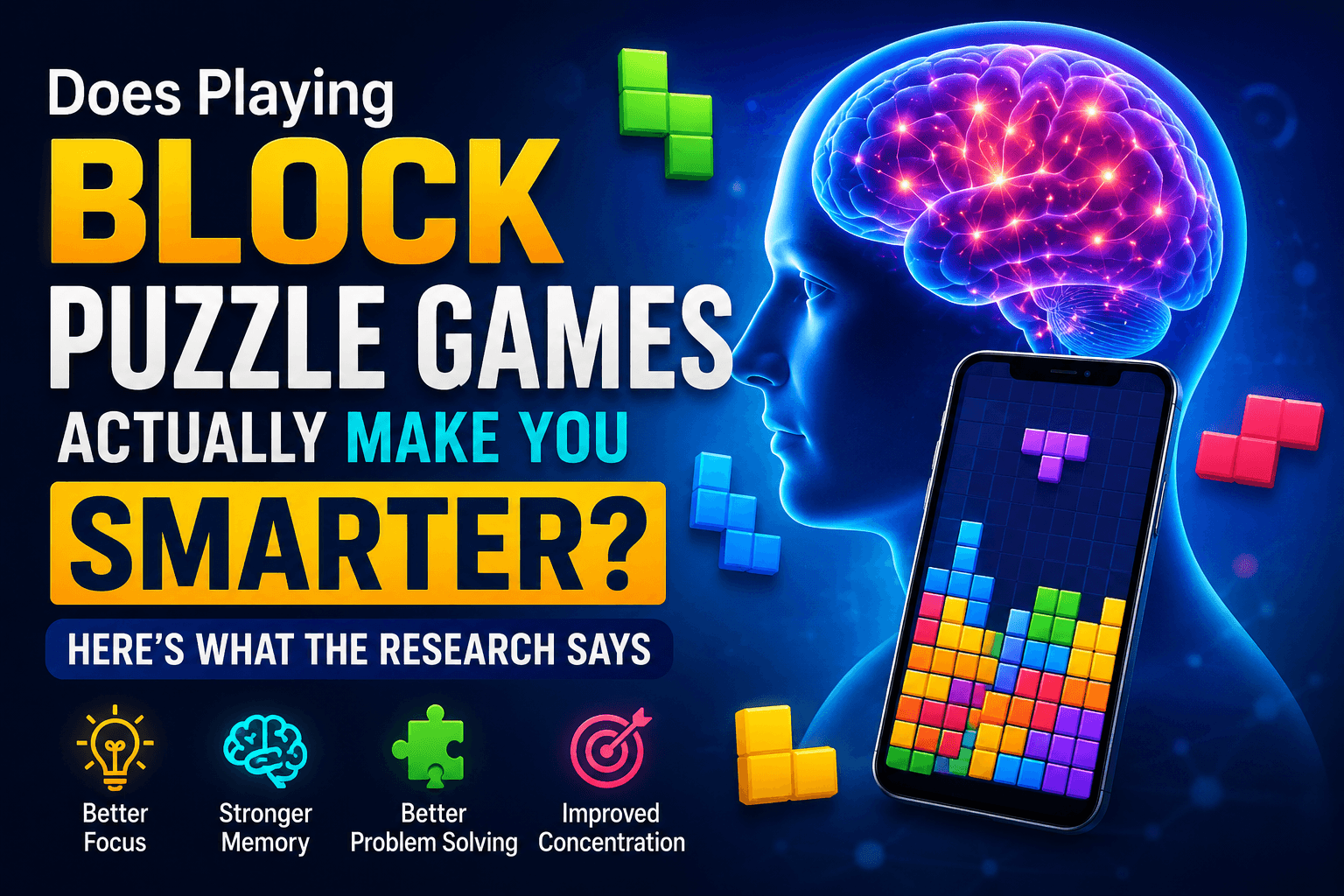
Does Playing Block Puzzle Games Actually Make You Smarter? Here’s What the Research Says
Most people download puzzle games for one simple reason: they’re fun.
But after spending enough time playing block puzzle games like Tetris or Tetra Brick Puzzle, many players start wondering about something else:
“Are these games actually good for my brain?”
It’s a fair question.
You’re constantly:
- solving patterns
- thinking ahead
- managing space
- making decisions quickly
So it definitely feels like your brain is working while you play.
Interestingly, research over the years suggests that puzzle games may actually help improve certain cognitive skills especially games built around strategy, spatial thinking, and pattern recognition.
That doesn’t mean playing Tetris suddenly turns someone into a genius overnight 😄
But it does suggest these games may positively affect focus, mental flexibility, and problem-solving abilities over time.
Let’s break down what the research and player experience actually say.
Why Puzzle Games Feel Mentally Engaging
Unlike passive entertainment, puzzle games require active thinking.
When playing a block puzzle game, your brain constantly processes:
- shape recognition
- spatial awareness
- planning
- risk management
- pattern prediction
Even simple decisions matter.
For example:
Do you place a block now for quick points?
Or save space for a larger piece later?
That type of decision-making keeps your brain engaged continuously.
Games like Tetra Brick Puzzle are especially interesting because they combine:
✔ simplicity
✔ repetition
✔ strategic thinking
in a way that feels relaxing instead of exhausting.
What Research Says About Tetris and the Brain
Over the years, several studies have explored how games like Tetris affect cognitive function.
Researchers have linked puzzle games to improvements in areas such as:
- visual processing
- attention
- mental rotation skills
- short-term problem solving
One reason Tetris became such an important game in psychology research is that it heavily activates spatial reasoning.
Your brain constantly tries to:
- rotate shapes mentally
- predict outcomes
- organize information efficiently
That repeated mental activity can strengthen certain cognitive pathways over time.
Some studies have even suggested puzzle games may help improve:
- concentration
- processing speed
- working memory
especially when played consistently in moderation.
Do Puzzle Games Improve Focus?
Possibly especially short-term focus.
Think about what happens when you’re deeply involved in a puzzle game:
- distractions fade away
- your attention narrows
- your brain enters a problem-solving mode
This focused mental state is one reason many people use puzzle games during:
- work breaks
- study sessions
- mental resets
Games like Tetra Brick Puzzle work well for this because they don’t overload players with constant pressure or complicated systems.
Instead, they encourage calm concentration.
That’s an important difference.
Some fast-paced games can become mentally draining, while strategic block puzzle games often create a more balanced experience.
Pattern Recognition Is a Real Mental Skill
One of the biggest things puzzle games train is pattern recognition.
The more you play, the faster your brain becomes at:
- identifying shapes
- recognizing opportunities
- predicting outcomes
- adapting strategies
This happens naturally over time.
You stop reacting randomly and start seeing patterns before they happen.
That skill isn’t only useful in games either.
Pattern recognition plays a role in:
- decision-making
- learning
- organization
- problem-solving in daily life
The “Tetris Effect” Is Actually Real
There’s even a famous psychological phenomenon called the Tetris Effect.
It happens when players spend enough time playing Tetris-style games that they start mentally visualizing blocks and patterns outside the game.
People have reported:
- imagining puzzle shapes during daily activities
- mentally organizing objects differently
- visualizing rotations automatically
While it sounds funny, it shows how deeply these games engage the brain’s visual and spatial systems.
Can Puzzle Games Reduce Stress Too?
Surprisingly, yes.
A lot of people assume games either:
- overstimulate the brain
or - waste time
But relaxing puzzle games can actually help reduce mental fatigue.
The key difference is pacing.
Games like Tetra Brick Puzzle avoid:
❌ aggressive timers
❌ overwhelming action
❌ constant interruptions
Instead, they create a calm loop of:
- focus
- planning
- reward
That rhythm can feel mentally refreshing, especially after long work sessions or heavy screen time.
Many players describe block puzzle games as:
- calming
- satisfying
- meditative
which probably explains why they remain so popular decades after Tetris first appeared.
Do Puzzle Games Increase IQ?
This is where expectations should stay realistic.
Research does not show that puzzle games magically increase intelligence overall.
However, they can improve specific cognitive abilities like:
✔ spatial reasoning
✔ reaction planning
✔ attention control
✔ mental flexibility
✔ visual processing
Think of it less like “becoming smarter” and more like:
giving certain parts of your brain regular exercise.
Just like physical workouts help different muscles, mental challenges help maintain cognitive activity.
Why Tetra Brick Puzzle Feels Different
A lot of modern mobile games rely heavily on:
- notifications
- pressure systems
- aggressive rewards
- overstimulation
Tetra Brick Puzzle feels more balanced.
It keeps the satisfying strategic feeling of classic Tetris-style gameplay while removing much of the stress.
That’s probably why players often describe it as:
- relaxing
- mentally engaging
- easy to return to daily
The combination of:
✔ no time pressure
✔ strategic gameplay
✔ smooth pacing
creates an experience that feels mentally active without becoming exhausting.
The Best Way to Use Puzzle Games
Puzzle games work best as part of a healthy routine not as nonstop distractions.
A short session during:
- study breaks
- work breaks
- commuting
- evening downtime
can actually feel refreshing.
Moderation matters.
The goal isn’t replacing productive activities with games.
It’s using mentally engaging games as a healthy form of relaxation and stimulation.
Final Thoughts
So… do block puzzle games actually make you smarter?
Not in some magical movie-style way 😄
But research does suggest that games like Tetris and Tetra Brick Puzzle can help improve:
- focus
- pattern recognition
- spatial reasoning
- strategic thinking
- mental engagement
And honestly, that’s probably one reason these games have remained popular for so many years.
They’re simple, satisfying, mentally engaging, and surprisingly relaxing at the same time.
👉 If you enjoy puzzle games that challenge your brain without overwhelming you, Tetra Brick Puzzle is definitely worth trying.