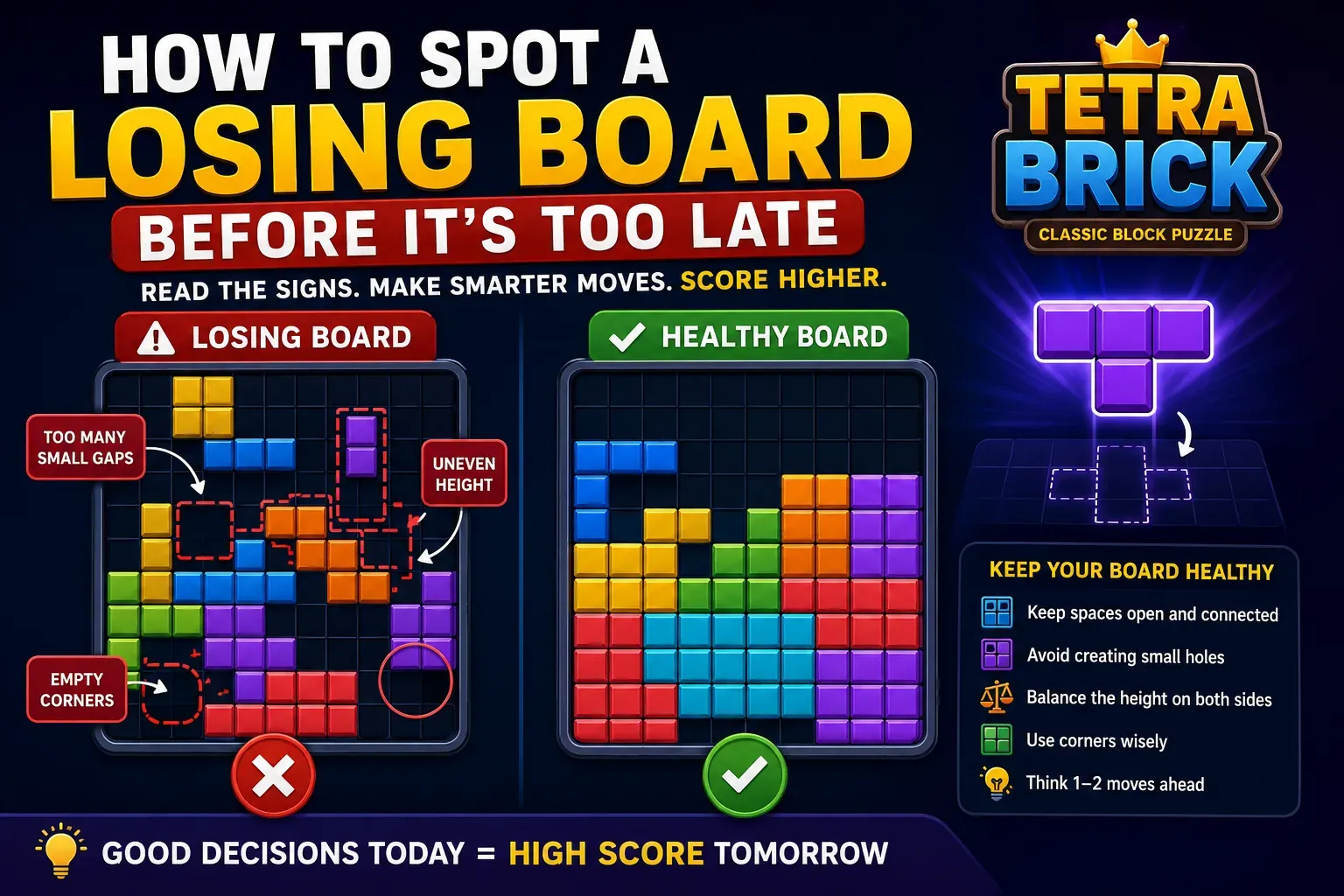
How to Spot a Losing Board Before It's Too Late
You don't lose a block puzzle game when the board is completely full.
You lose it several moves earlier.
That's what makes block puzzle games so fascinating—and sometimes frustrating. Your board can look perfectly manageable one moment, only to become impossible a few turns later. By the time you realize you're in trouble, it's often too late to recover.
Many players blame bad luck when this happens. They think the game simply gave them the wrong pieces.
In reality, most losing boards are created slowly through a series of small decisions. A misplaced block here, an ignored corner there, and suddenly the board has fewer and fewer places where new pieces can fit.
The encouraging news is that every losing board leaves warning signs before it collapses.
Learning to recognize those signs is one of the biggest differences between average players and those who consistently achieve high scores.
Whether you're trying to beat your personal best in Tetra Brick or simply enjoy longer, more relaxing games, understanding board health will help you make smarter decisions and keep your game alive far longer.
What Is a Losing Board?
A Losing Board Is One That Has Lost Its Flexibility
Many people think a dangerous board is simply one that's almost full.
That's only part of the story.
A board with plenty of empty spaces can actually be in worse condition than one that's nearly full.
Why?
Because empty space is only valuable if you can actually use it.
Imagine looking at your board and seeing fifteen or twenty empty squares. At first glance, everything seems fine. But those empty spaces are scattered into tiny gaps that only one specific piece could fill.
Now imagine the next three pieces don't fit those gaps.
The game is over.
This is why experienced players judge a board by its flexibility, not by the number of empty cells.
A healthy board can accept many different block combinations.
A losing board can only accept one or two.
Once your options become limited, every new piece becomes harder to place.
Why Players Often Miss the Warning Signs
The Board Usually Looks Fine Until It Doesn't
One reason block puzzle games are so addictive is that problems develop gradually.
You rarely make one obvious mistake that immediately ends your run.
Instead, small issues accumulate.
Perhaps you leave one awkward gap.
Then another.
You build one side slightly higher than the other.
You ignore an empty corner because another placement seems easier.
None of these decisions feels significant by itself.
But together they slowly reduce your available space.
By the time you notice something is wrong, you've already spent several turns creating the situation.
That's why learning to recognize early warning signs is so valuable.
It allows you to fix problems while the board is still recoverable.
Warning Sign #1: Too Many Small Gaps
Tiny Empty Spaces Are More Dangerous Than They Look
One of the earliest signs of a struggling board is the appearance of scattered one-block and two-block holes.
These spaces often seem harmless.
After all, they're still empty.
The problem is that very few pieces can actually use them efficiently.
As more tiny gaps appear, your board becomes fragmented.
Instead of having one large working area, you now have several isolated pockets that limit future placements.
Professional players constantly ask themselves:
"Am I creating useful space—or unusable space?"
Whenever possible, try to connect open areas instead of dividing them into smaller sections.
The more connected your empty space remains, the more options you'll have when new pieces appear.
Warning Sign #2: One Side of the Board Keeps Growing
Uneven Boards Become Difficult to Control
Look at your board for a moment.
Is one side significantly taller than the other?
If so, you're creating one of the most common losing patterns in block puzzle games.
Tall stacks reduce your flexibility.
Long pieces become harder to place.
Large shapes no longer fit comfortably.
Eventually, you're forced into making placements simply because they're the only available option.
A balanced board gives you freedom.
An uneven board forces decisions.
Whenever one section begins growing noticeably higher, spend the next few turns leveling it before continuing your normal strategy.
This small adjustment often prevents much bigger problems later.
Warning Sign #3: Empty Corners That Never Get Used
Corners Become Traps If You Ignore Them
Corners are surprisingly important.
Many players avoid them early because the middle of the board feels easier to manage.
Unfortunately, neglected corners rarely become easier to fill later.
As your board fills, those corners become isolated spaces surrounded by other blocks.
Only a handful of shapes can fit naturally.
If those shapes don't appear, you've permanently lost valuable space.
Strong players treat corners differently.
Instead of waiting until they're forced to use them, they gradually build into corners while the board is still open.
Doing this keeps every part of the grid active and usable throughout the game.
Warning Sign #4: You're Making Decisions Too Quickly
Fast Doesn't Always Mean Better
Block puzzle games don't usually have countdown timers.
There's no prize for placing pieces instantly.
Yet many players rush every move.
When your board is healthy, quick decisions rarely cause major problems.
When the board starts becoming crowded, however, rushing is often what turns a recoverable situation into a game over.
Take an extra five seconds before placing each block.
Look across the entire board.
Consider two or three possible positions instead of immediately choosing the first one that fits.
That brief pause often reveals better opportunities you would have otherwise missed.
Warning Sign #5: Every Move Feels Like a Compromise
You're Running Out of Good Options
Healthy boards give you choices.
Dangerous boards don't.
If you notice yourself thinking:
"I guess this is the only place it fits..."
over and over again, your board is already telling you something.
You're no longer making strategic decisions.
You're simply surviving.
That's a major warning sign.
The goal should always be maintaining multiple placement options.
Once every move becomes a compromise, recovery becomes much harder.
Instead of asking where the current piece fits, ask how your placement will affect the next several turns.
That shift in thinking is one of the fastest ways to improve your long-term results.
Healthy Boards Have Common Characteristics
Good Players Build Flexible Boards on Purpose
If you watch experienced block puzzle players, you'll notice they rarely rely on luck.
Instead, they build boards with similar characteristics:
- Open connected spaces
- Balanced height across the grid
- Active corners
- Very few isolated holes
- Plenty of room for large pieces
These aren't accidents.
They're the result of consistent habits repeated every game.
The best players don't wait until their board becomes dangerous.
They prevent it from becoming dangerous in the first place.
How to Recover When You Spot a Losing Board
Don't Try to Score Big—Focus on Saving the Board
One of the biggest mistakes players make is chasing high-scoring moves when their board is already in trouble.
When space becomes limited, your priority should change.
Instead of asking, "How can I clear the most lines?", ask:
"How can I make my board easier to play?"
Sometimes that means taking a smaller line clear.
Sometimes it means placing a piece in a position that doesn't score immediately but creates a large open area for future moves.
Think of it like cleaning a cluttered desk. Before you can work efficiently again, you need to create space.
The same principle applies to block puzzle games.
Use the 10-Second Board Health Check
A Simple Routine Before Every Move
Experienced players don't rely on instinct alone. They develop routines that help them evaluate the board before making important decisions.
A quick mental checklist can prevent many unnecessary mistakes.
Before placing any block, ask yourself these five questions:
1. Am I creating a new isolated gap?
Small holes are difficult to use later. If the answer is yes, look for another placement.
2. Will this make one side of the board much taller?
Balanced boards are easier to manage throughout the game.
3. Can I still place a long piece afterward?
Always leave enough uninterrupted space for larger shapes.
4. Am I protecting at least one open area?
Keeping a flexible section of the board available makes future turns much easier.
5. Does this move improve or reduce my options?
This is the most important question.
Good players don't simply solve the current move—they prepare for the next one.
Know When to Sacrifice Points
Long Games Usually Beat Big Moves
Many beginners believe every move should maximize points.
Experienced players know that's not always true.
Sometimes taking a smaller scoring opportunity keeps the board healthy.
For example, imagine you can clear one row immediately, but doing so creates several awkward gaps.
Alternatively, you could delay that clear, smooth out the board, and create more placement options.
The second choice often leads to a much longer game.
Longer games naturally produce more scoring opportunities.
Ironically, playing conservatively often results in higher final scores.
Develop Habits That Prevent Losing Boards
Consistency Beats Luck Every Time
High scores don't happen because experienced players receive better pieces.
They happen because experienced players make better decisions repeatedly.
Here are five habits worth developing:
Think One Move Ahead
You don't need to predict the entire game.
Simply considering your next move before placing the current piece makes a noticeable difference.
Build Across the Board
Avoid focusing only on one section.
Keeping the entire grid active prevents overcrowding.
Fill Difficult Spaces Early
Corners and narrow gaps become much harder to use later.
Deal with them while the board is still open.
Avoid Panic Placements
Crowded boards tempt players to rush.
Slow down instead.
The extra few seconds often reveal better options.
Learn From Every Game
Instead of immediately starting another round after losing, spend a moment looking at your final board.
Ask yourself:
- Where did the problems begin?
- Which area became difficult first?
- Could I have prevented it five moves earlier?
These reflections help you improve much faster than simply playing more games.
Why These Strategies Work So Well in Tetra Brick
Better Board Management Leads to Better Scores
One of the reasons Tetra Brick remains enjoyable is that every decision matters.
There are no timers forcing rushed placements, allowing players to think carefully before committing to a move.
That makes strategic planning incredibly rewarding.
Players who focus on board health often discover that:
- Games last significantly longer.
- Large combo opportunities appear more naturally.
- Stress decreases because the board feels manageable.
- Personal best scores become more consistent.
Instead of relying on lucky piece combinations, you're building a strategy that works regardless of what appears next.
That's a far more reliable way to improve.
The Best Players Don't Avoid Mistakes They Spot Them Early
Recovery Starts With Awareness
Even expert players occasionally create awkward boards.
The difference is that they recognize the warning signs before the situation becomes critical.
They notice:
- Growing stacks.
- Wasted corners.
- Scattered gaps.
- Limited placement options.
Then they immediately adjust their strategy.
Recovery isn't about perfection.
It's about recognizing problems early enough to fix them.
That's a skill anyone can develop with practice.
Final Thoughts
Every block puzzle game tells a story.
At the beginning, the board is full of possibilities.
As the game progresses, every placement either creates new opportunities or quietly removes them.
Most losing boards don't appear suddenly.
They develop gradually through a series of small choices that reduce flexibility until no good moves remain.
The encouraging part is that this process works both ways.
The same small decisions that slowly destroy a board can also keep it healthy.
By paying attention to warning signs, maintaining balanced space, protecting open areas, and thinking one or two moves ahead, you'll begin surviving much longer than before.
The next time you play Tetra Brick, don't wait until your board feels crowded.
Start watching its health from the very first move.
You'll quickly discover that longer games—and higher scores—come from better decisions, not better luck.
Frequently Asked Questions
1. How do I know if my block puzzle board is about to fail?
Common warning signs include too many isolated gaps, uneven stacks, unused corners, and very limited placement options for incoming pieces.
2. Why do I lose even when my board isn't full?
Because flexibility matters more than empty space. If the remaining spaces can't fit available pieces, the game ends even though empty cells still exist.
3. What's the best way to recover from a crowded board?
Slow down, prioritize creating larger connected spaces, avoid new isolated holes, and place difficult shapes while you still have room.
4. Should I always clear lines immediately?
No. Sometimes delaying a line clear helps maintain a healthier board, giving you more placement options and leading to higher scores over time.
5. Does planning ahead really improve block puzzle performance?
Yes. Even thinking one or two moves ahead helps you avoid awkward board layouts, preserve flexibility, and extend your gameplay.