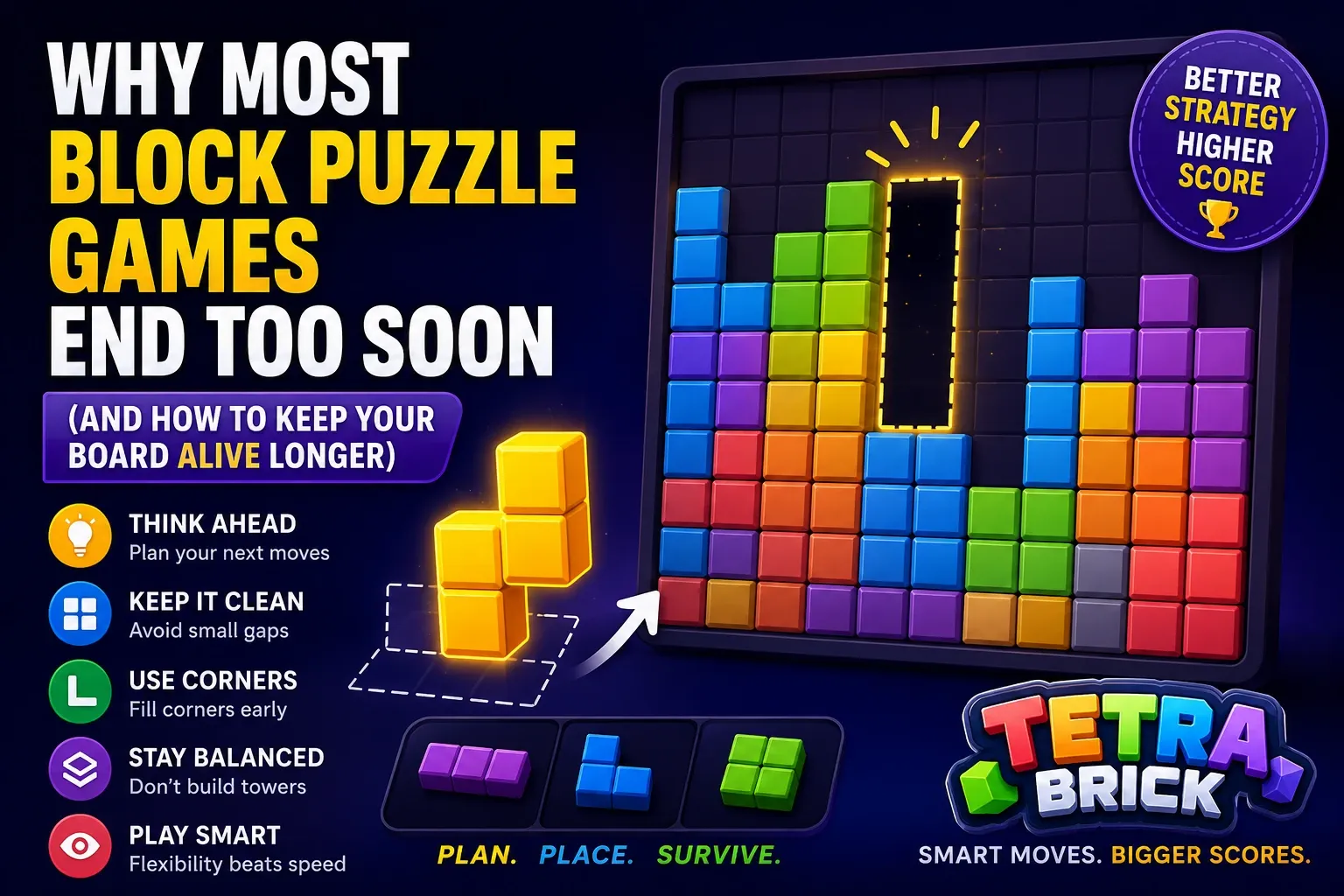
Block puzzle games look simple at first glance. You drag shapes onto a grid, clear lines, earn points, and keep playing until there is no room left. There are no timers to rush you, no enemies to defeat, and no complicated controls to master. Yet almost every player has experienced the same frustrating moment: one minute the board feels wide open, and a few moves later, every available space seems impossible to use.
It rarely feels like you made a huge mistake. Instead, your game ends unexpectedly, leaving you wondering what changed.
The truth is that most block puzzle games do not end because of bad luck. They end because of a series of small decisions that slowly reduce your available options. Every block you place changes the future of the board, and those tiny choices add up much faster than most players realize.
The good news is that this is a skill you can improve. By understanding how successful players manage space instead of simply chasing points, you can survive much longer, build higher scores, and enjoy a more satisfying gameplay experience.
Whether you are new to block puzzle games or trying to beat your personal best in Tetra Brick, these strategies will help you think further ahead and keep your board alive for many more moves.
Why Do Most Block Puzzle Games End So Quickly?
Because the Board Runs Out of Flexibility Before It Runs Out of Space
Many players believe the game ends because the board becomes full. In reality, most games end long before every square is occupied.
The real problem is flexibility.
Imagine having twenty empty spaces left on the board. That sounds like plenty of room, but if those spaces are scattered into tiny gaps, none of your available pieces may actually fit. Suddenly, the game is over despite having lots of empty cells.
This is why experienced players rarely judge a board by how much empty space it has. Instead, they look at how usable that space is.
A clean, organized board with fewer empty squares is often much healthier than a messy board with large numbers of isolated gaps.
Thinking about flexibility instead of simply filling spaces is one of the biggest mindset shifts that separates casual players from high scorers.
Every Placement Shapes Your Future
Each Move Is an Investment, Not Just a Solution
Every time you place a block, you are doing more than solving the current turn.
You are also deciding what your next five or ten moves might look like.
Many placements appear equally good in the moment. They may score the same number of points or clear the same number of lines. However, one placement often leaves the board smooth and open, while another creates awkward corners, uneven edges, or isolated gaps.
Those differences may seem insignificant after one move, but after twenty or thirty moves they become the reason your game survives—or ends.
Instead of asking yourself,
"Where does this block fit?"
Start asking,
"Which placement leaves me with the most options afterward?"
That simple question changes the way you approach every puzzle.
Mistake #1: Focusing Only on Immediate Line Clears
Clearing a Line Is Good—Protecting Your Board Is Better
Few things feel more satisfying than completing a row and watching it disappear.
Because of that reward, many players naturally chase line clears whenever they become available.
Unfortunately, the obvious move is not always the best one.
Imagine you have a nearly completed row with only one gap remaining. Filling that gap will clear the line immediately.
But what if using that piece somewhere else would smooth out a messy section of your board and create several future placement opportunities?
In many situations, delaying one line clear actually leads to a much longer game.
High-scoring players understand that board health matters more than instant rewards.
Sometimes leaving a row unfinished for one extra turn gives you better positioning, cleaner surfaces, and greater flexibility later.
Remember that the opportunity to clear a line usually comes back.
A badly shaped board is much harder to fix.
Mistake #2: Ignoring the Corners
Empty Corners Become Big Problems Later
Corners are some of the most difficult areas to manage in any block puzzle game.
Unlike the center of the board, corners have fewer connecting directions. That means fewer pieces naturally fit there without creating awkward shapes.
Many players avoid placing blocks in the corners during the early game because the middle feels easier to work with.
Unfortunately, this habit creates trouble later.
As the board fills, those untouched corners become isolated dead zones that only very specific pieces can use.
When those pieces never arrive, valuable space goes to waste.
A smarter strategy is to gradually build into your corners while the board is still open.
Small square blocks, short bars, and simple shapes are perfect for establishing clean foundations early.
By treating corners as valuable real estate instead of emergency storage, you make your late-game much more manageable.
Mistake #3: Creating Too Many Small Gaps
Tiny Holes Are Harder to Fix Than Large Open Spaces
One of the quickest ways to lose a block puzzle game is by filling your board with scattered one-cell and two-cell holes.
These tiny spaces may not seem dangerous individually.
However, after several moves they become impossible to use efficiently.
Every isolated gap limits the number of pieces that can fit naturally.
Eventually you reach a point where the board contains plenty of empty cells but none of your available pieces can use them.
Whenever possible, prioritize building large connected areas instead of fragmented spaces.
Large open sections can accept many different shapes.
Small isolated holes can usually accept only one or two.
The more flexible your open space remains, the longer your game is likely to last.
Mistake #4: Building Towers Instead of Flat Surfaces
Uneven Boards Reduce Your Options
Many players accidentally create one tall section while leaving another side of the board nearly empty.
This creates an uneven playing field that becomes increasingly difficult to manage.
Tall stacks limit where long pieces can fit and often trap awkward shapes underneath them.
Instead, aim to keep the overall height of your board balanced.
Think of your board as a landscape.
Smooth hills are much easier to build on than steep mountains.
Whenever you notice one area growing significantly higher than the rest, use the next few turns to even it out before continuing your normal strategy.
This habit alone can dramatically increase the length of your runs.
Think Two or Three Moves Ahead
Planning Beats Reacting Every Time
One of the biggest differences between beginners and experienced players is planning.
New players solve the current move.
Experienced players solve the next three.
Before placing any block, pause for a second and imagine how the board will look afterward.
Ask yourself:
- Will this create awkward holes?
- Does this block reduce future placement options?
- Will it make long pieces harder to place later?
- Am I protecting enough open space?
These questions only take a few seconds to answer, yet they often prevent mistakes that could end your game several turns later.
Over time, this type of thinking becomes automatic, allowing you to recognize strong placements almost instantly.
How to Keep Your Board Alive Longer
Play for Flexibility Instead of Perfect Moves
One of the biggest misconceptions about block puzzle games is that every move has a single "correct" answer. In reality, the best move is often the one that keeps the greatest number of future possibilities open.
Instead of focusing only on where a piece fits today, think about how that placement affects the next several turns. A move that leaves a wide, open playing area is usually more valuable than one that scores immediately but creates awkward gaps.
Ask yourself one simple question before placing each piece:
"Will this move make my next turn easier or harder?"
Making this a habit helps you avoid short-term decisions that slowly trap your board.
Keep an Escape Lane Open
Always Leave Yourself Room for Difficult Pieces
Every block puzzle game includes pieces that are harder to place than others. Long bars, L-shaped blocks, and unusual combinations often require larger open spaces.
If every section of your board becomes crowded, these pieces quickly become impossible to use.
A helpful strategy is to maintain at least one row or one column with relatively open space. Think of it as an emergency lane that gives you somewhere to place difficult shapes without disturbing the rest of the board.
You won't always need it, but when a challenging piece appears, you'll be glad it's there.
Learn to Recognize Dangerous Board Patterns
Spot Problems Before They Become Game Over
Great players don't wait until the board is almost full before making adjustments. They constantly look for warning signs that indicate trouble is building.
Some of the most common danger signals include:
- Several isolated one-block gaps.
- One side of the board significantly higher than the other.
- Empty corners surrounded by filled blocks.
- Long narrow spaces that only one specific shape can fill.
- Multiple unfinished rows stacked together.
The earlier you notice these patterns, the easier they are to fix.
Once the board becomes crowded, every correction becomes more difficult.
Recovering From a Crowded Board
Don't Panic When Space Gets Tight
Almost every player experiences moments where the board suddenly feels overwhelming.
This is often where games are won or lost.
Many players begin placing pieces as quickly as possible, hoping to create room before it's too late. Ironically, rushing usually makes the situation worse.
Instead, slow down.
Carefully examine the entire board before making your next move. Sometimes the best placement isn't the most obvious one.
If you have several pieces available, consider using the most awkward shape first while you still have options. Smaller, more flexible blocks can usually fit into leftover spaces later.
A calm decision made on a crowded board is often enough to save an entire run.
Build Consistent Habits Instead of Chasing High Scores
Good Habits Naturally Lead to Better Scores
Players who constantly watch their score often make unnecessary risks.
Instead, focus on repeating strong habits every game:
- Keep the board balanced.
- Fill corners early.
- Avoid isolated gaps.
- Protect open space.
- Think ahead before every placement.
These habits create longer games.
Longer games create more line clears.
More line clears naturally produce higher scores.
Rather than trying to force a record-breaking game, concentrate on making consistently smart decisions. The scores will improve as a result.
Why These Strategies Work So Well in Tetra Brick
Better Planning Creates Better Combos
One of the reasons players enjoy Tetra Brick is that success comes from thoughtful planning rather than luck.
The game rewards players who manage their space carefully and stay patient under pressure.
Every extra move you survive creates another opportunity to clear multiple lines, build larger combos, and beat your previous high score.
Because there are no timers forcing quick decisions, you have the freedom to evaluate each move before committing to it. Taking advantage of that freedom often separates average runs from your personal best.
Whether you're playing for a few relaxing minutes during a break or aiming for the top of the leaderboard, good board management makes every game more enjoyable.
Practice Makes Pattern Recognition Faster
Experience Trains Your Brain
One of the most satisfying aspects of block puzzle games is seeing your improvement over time.
At first, planning several moves ahead may feel difficult.
After enough games, however, your brain naturally begins recognizing useful patterns.
You'll start noticing:
- Which shapes commonly create problems.
- Which areas of the board become difficult to recover.
- Which placements leave the most flexibility.
- Which mistakes usually lead to an early game over.
This pattern recognition develops naturally through practice.
Instead of reacting to every piece individually, you'll begin thinking in terms of overall board health.
That's when the game becomes even more rewarding.
Common Myths About Block Puzzle Games
More Empty Space Doesn't Always Mean You're Safe
Many players assume an almost empty board is automatically a healthy board.
Not necessarily.
If the available space is fragmented into awkward gaps, you can still lose surprisingly quickly.
What matters is not how much empty space you have, but how useful that space is.
Luck Is Not the Biggest Factor
While the order of pieces introduces variety, consistent high scores come from strong decision-making.
Experienced players repeatedly outperform beginners because they understand how to manage space effectively.
Skill always has a greater impact than luck over the course of a long game.
Final Thoughts
Block puzzle games are easy to learn but surprisingly deep once you understand what keeps a board alive.
Most games don't end because of one unlucky piece or one obvious mistake. They end because small decisions slowly remove your future options until no placement remains.
The encouraging part is that every one of those decisions is within your control.
Focus on flexibility instead of rushing for quick line clears. Build balanced boards, protect open space, use corners wisely, and think a few moves ahead whenever possible.
These habits won't transform your game overnight, but you'll quickly notice something important: your boards stay cleaner, your runs last longer, and your scores begin to improve naturally.
The next time you launch Tetra Brick, challenge yourself to play with patience rather than speed. Slow down, study the board, and treat every placement as an investment in the moves to come.
You may be surprised by how much longer your game lasts—and how much more satisfying every high score becomes.
Frequently Asked Questions
1. Why do block puzzle games suddenly become impossible?
Most games become difficult because earlier placements create isolated gaps and uneven spaces. The board loses flexibility, making it impossible for new pieces to fit even when empty cells remain.
2. Is luck important in block puzzle games?
Luck influences which pieces appear, but long-term success depends much more on planning, space management, and recognizing useful patterns.
3. How can I survive longer in Tetra Brick?
Keep your board balanced, avoid creating small isolated holes, fill corners early, leave room for difficult pieces, and always think a few moves ahead before placing a block.
4. Should I always clear a line as soon as possible?
Not always. Sometimes delaying a line clear helps maintain a cleaner board and creates better opportunities for larger combos later in the game.
5. What is the most common mistake beginners make?
The biggest mistake is focusing only on the current move instead of considering how each placement affects future options. Strong players prioritize board flexibility over immediate rewards.