zzle Games Are So Hard to Put Down
So what makes block puzzles so compelling? Psychologists point to several ingredients that work together.
Clear goals and instant feedback
You always know what you're trying to do: fill a line. And you find out right away whether your move worked. That tight loop of action and result is deeply satisfying, and it's something everyday tasks rarely give us.
Small, frequent rewards
Every cleared line is a tiny win. The brain's reward system, which involves the chemical messenger dopamine, responds to these moments of success and to the anticipation of the next one. That's part of why a clean multi-line clear feels so good, and why you want to chase the next one.
The "flow" state
When a challenge sits just above your current skill, it's easy to become fully absorbed. Psychologists call this flow. Time seems to pass quickly, distractions fade, and you're simply focused on the board. Block puzzles are good at creating flow because they're simple to grasp but always offer a slightly better move to find.
Unfinished business
Our minds tend to hold on to tasks that feel incomplete. A game that ends just short of your high score leaves a little itch to try again. Add the fact that every round starts fresh, and "just one more round" becomes very easy to say.
We explore this further in why puzzle fans love the "one more round" feeling.
What is the "Tetris effect"?
The Tetris effect is a real psychological term. It describes what happens when you spend so long on an activity that it starts to shape your thoughts, images, and even dreams, like seeing falling blocks when you close your eyes, or mentally fitting real-world objects together. It's a striking sign of how strongly puzzle patterns can stick in the mind.
4. How Puzzle Games Engage Your Brain
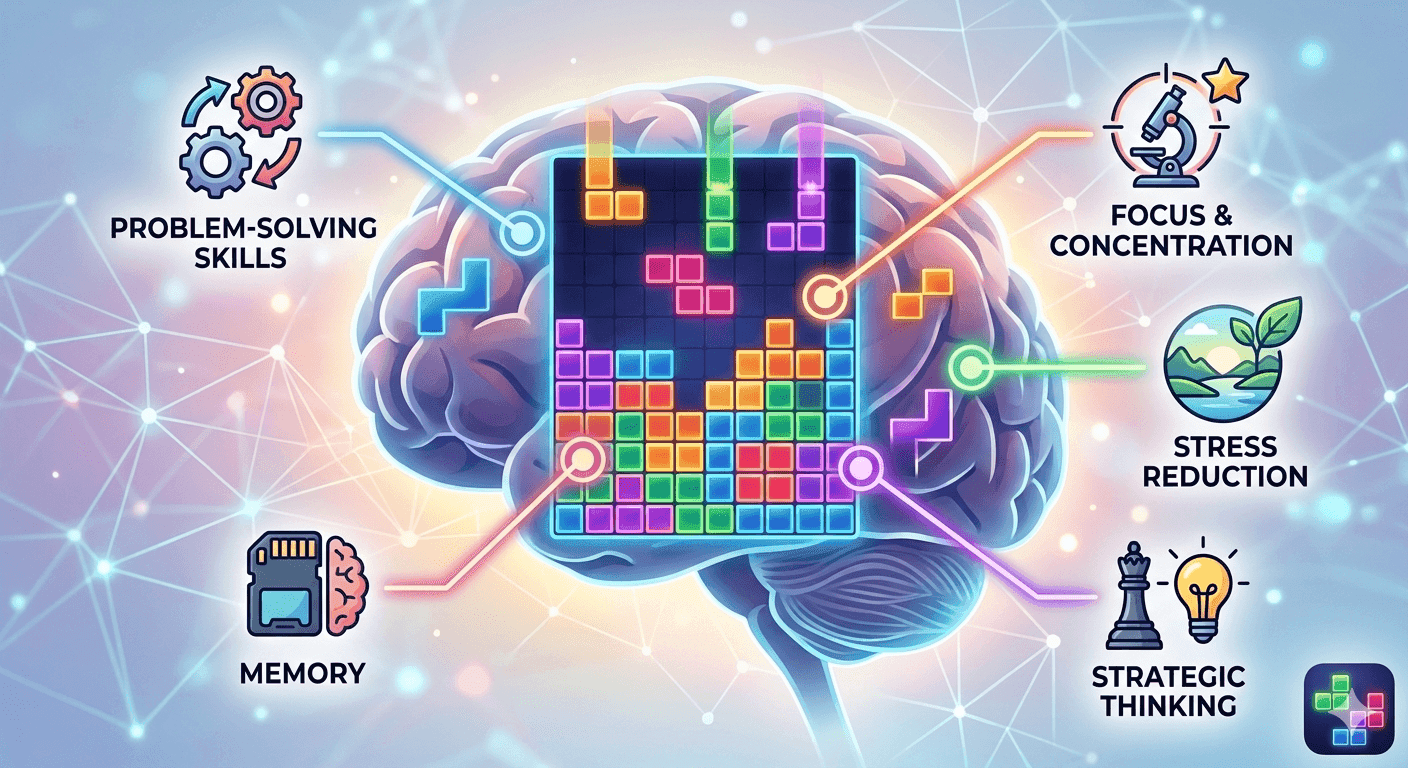
Block puzzles aren't only fun. Each round also asks your brain to work in several ways at once:
- Working memory: you hold the shapes in your tray in mind while picturing where they could go.
- Focus and attention: one careless placement can cause trouble later, so you learn to stay with the board.
- Spatial reasoning: you constantly visualize how shapes will fit next to each other on the grid.
- Planning: good players think two or three moves ahead, not just about the current piece.
People tend to get better at the specific skills they practice, and staying mentally active is part of a healthy routine. Evidence that a single game makes you broadly smarter is still limited and debated, though. The best way to think of block puzzles is as an enjoyable mental workout, alongside good sleep, exercise, and learning new things.
Curious about the evidence? See does playing block puzzle games actually make you smarter?
Many players also find that a calm puzzle helps them unwind. With no timer pushing them, they can give their mind one simple problem to focus on for a few minutes.
5. Why Tetra Brick Puzzle Stands Out
Tetra Brick Puzzle takes the psychology that makes block puzzles compelling and leans into its calmest side:
- No time limits: you can think through every move, which makes flow easier to find and stress easier to leave behind.
- Simple drag-and-drop controls: anyone can start playing in seconds.
- Easy to learn, hard to master: smarter planning leads to bigger clears and higher scores.
- A clean, distraction-free design: nothing on screen competes with the puzzle.
- Offline play: you can play anywhere, without notifications pulling you away.
The result keeps the satisfying "one more round" pull of the classics while dropping the pressure.
6. How to Enjoy Puzzle Games in a Healthy Way
A game that's hard to put down is a good thing, as long as it stays a choice. These habits help:
- Set a natural stopping point. Decide on one or two rounds before you start, and stop after a satisfying clear.
- Take breaks. Puzzles need focus, so short pauses help you stay sharp and avoid eye strain.
- Play with intention. Plan each move instead of placing pieces on autopilot. It's more rewarding and better practice.
- Enjoy the process. Chasing a high score is fun, but the real pleasure is in solving each board.
- Keep balance. Mix puzzle time with movement, people, and time away from screens.
Frequently Asked Questions
Why are puzzle games so addictive?
They combine clear goals, instant feedback, frequent small rewards, and a challenge that matches your skill. Together, these create a focused flow state and a strong urge to try "one more round."
What does dopamine have to do with puzzle games?
Dopamine is a chemical messenger involved in the brain's reward system. Moments of success, like clearing a line, and the anticipation of the next one are part of what makes puzzles feel satisfying.
What is the Tetris effect?
It's when an activity you've done for a long time starts to shape your thoughts, mental images, or dreams, such as seeing falling blocks when you close your eyes.
Are puzzle games good for your brain?
They exercise working memory, focus, spatial reasoning, and planning. They're a fun way to stay mentally active, though they aren't a substitute for sleep, exercise, or learning.
How is Tetra Brick Puzzle different from Tetris?
In Tetris, pieces fall and the game speeds up. In Tetra Brick Puzzle, you drag pieces onto the grid at your own pace with no timer, so it's calmer and more about planning.
Where can I download Tetra Brick Puzzle?
Tetra Brick Puzzle is available on iPhone through the App Store.
Conclusion
The pull of puzzle games isn't a mystery. Clear goals, quick rewards, a challenge that matches your skill, and an always-beatable high score combine into something that's genuinely hard to put down.
Tetra Brick Puzzle brings that classic magic to your phone with a calmer twist: no timers, no pressure, just you, the board, and the next smart move. Whether you want a fun challenge or a few quiet minutes to unwind, it's a great way to enjoy the psychology of puzzles at your own pace.
👉 Download Tetra Brick Puzzle on the App Store and see how long "just one more round" lasts.